
Your first-session plan
- Choose the kind of run you want. Use the difficulty guide before committing to a trophy-focused run. If you mainly want to learn directional combat, understand which assists the preset changes instead of treating its name as a damage multiplier.
- Keep a recoverable save. Make a separate manual save before a major commitment, and retain one before the final quest. PowerPyx's launch roadmap reports manual saves and a return to the title screen after an ending, rather than post-ending free roam. This is a save-management precaution, not a claim that every choice can be reversed from one late save.
- Scout, then commit. Check the hourglass attached to the actual quest or dialogue action. Exploration and combat alone do not spend the story clock; completing a marked action can. Use the time rules below to decide what to do before it.
- Check what your current form can use. A learned skill is not automatically useful in both halves of the day. The skill directory and progression notes explain the shared point pool, manuals and tree-specific access.
- Choose the next task by its obstacle. Need a sword or an upgrade: open weapons. Stuck on a village objective: use the selected quest walkthroughs, which contain spoilers. A blocked route or shrine belongs in fast travel.
Quicksave before dangerous fights and periodically while exploring. PowerPyx’s save guidance warns that free-roam progress is not automatically saved.
This is a practical reading order, not a tested speedrun or an optimal quest schedule. The clock rules come from the developer's time-system explanation; the detailed pages identify their own source versions.
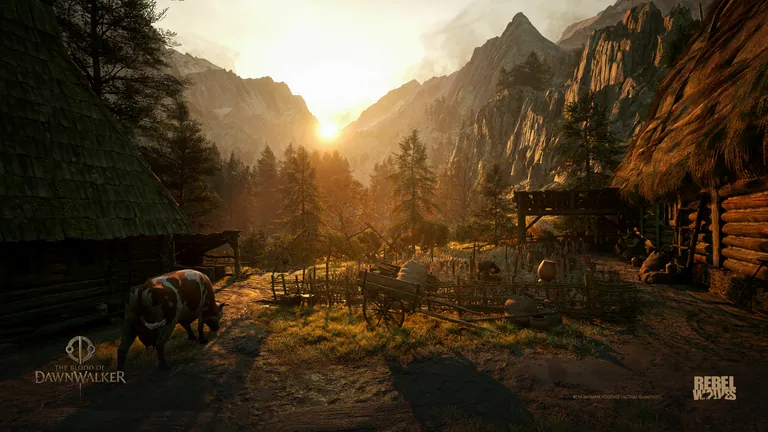
What Is The Blood of Dawnwalker?
You play as Coen, an ordinary, poverty-stricken man turned into a vampire against his will. Unlike most vampires in this setting, Coen can still move among humans in daylight — the curse doesn't fully take over until night. The game is set in a 14th-century European world called Vale Sangora, caught between war, plague, and open superstition about vampires, and Coen's own goal is to save his family and protect his home while figuring out what he's become. Choices you make shape how the story plays out and how the world reacts to you — this guide won't spoil which choices lead where.
The Core Loop — Day and Night
There are three skill trees in total: Witchcraft is used by day, Vampirism by night, and Swordmastery works during both. Night opens a different toolkit without taking away Coen's ability to use equipped weapons and Swordmastery.
By day, Coen is human: sword attacks through the Swordmastery tree, plus hexes and blood magic through the Witchcraft tree. He can move openly through towns and talk to NPCs, and heals through items and consumables. By night, the Vampirism tree opens up: claw attacks (no weapon needed), Shadowstep (a long jump to distant places), and Planeshift (walking on walls and ceilings). Feeding raises Corruption and opens Vampirism options. Manage hunger separately: the developer calls the nighttime loss-of-control risk Blood Hunger. Game8's September 4 guide reports critical hunger at one Health Segment or less, when Coen may lose control during a conversation and drain the person he is talking to. Check his Health before approaching an important NPC; this is not a claim that high Corruption directly makes him attack anyone he passes. Source: Game8: Hunger and Feeding.
The community New Player Help notes describe 8 visible segments per day or night. Specific actions advance them: learning skills, quest actions, certain dialogue choices and waiting. Ordinary exploration and combat do not advance this budget. For example, you can explore before a time-costing quest action without spending segments just by walking; committing to the marked action can spend them.
The Rescue Deadline and the Prologue
The rescue window is 30 days and 30 nights. The developer explains that reaching the deadline does not simply end the game, but can have consequences for Coen's family. Actions with a time cost are marked with an hourglass and show the cost before you commit. A day/night switch is one part of that larger budget, not a fresh reset of the rescue deadline.
The prologue has its own missable activities. Sacred Covenant can enter the journal after Like Father, Like Son while there is still daylight for other quests. The commitment to watch is Blood Mass: returning to Pieter to wait skips the remaining daylight, and exhausting the prologue budget begins the event automatically. Finish the village activities you want before that commitment. See the prologue route and cutoff and PowerPyx’s Sacred Covenant walkthrough. This is separate from the overall 30-day-and-night rescue window.
Before you spend a time segment
| What you are about to do | What to check first |
|---|---|
| Explore a road, inspect the surroundings or fight an ordinary encounter | Take time to learn the area. These activities do not run down a continuous real-time clock. |
| Complete an objective or select a marked dialogue choice | Read that action's hourglass cost before confirming. Do not assume all dialogue or every quest costs the same amount. |
| Move a plan from day to night | Recheck the abilities and access it needs. A change of form is a change of available options, not a reset of the family rescue window. |
| Approach someone at night while blood-starved | Resolve the hunger risk first. The developer warns that insufficient blood can cause Coen to lose control and attack an NPC. |
Example: you can examine a route before accepting its time-costing outcome. The official gameplay recap illustrates this with a burning-house activity: real-world time spent investigating does not by itself advance its narrative clock. That does not make every quest consequence-free; the marked commitment still matters.
Source: Community Bulletin Board #2. Its Blood Hunger warning describes the risk, not a safe universal health threshold for every encounter.
Combat and Progression Basics
The Prologue teaches the core combat controls before Coen's family goes missing: Directional Attack vs. Omniattack, Perfect Block (choose a block direction right before a hit lands, which leaves the enemy open), Directional Block (block from four directions), and Perfect Dodge (precise pre-hit timing that costs no stamina, unlike a regular dodge). It ends with a fight against Brencis that can go two different ways — no spoilers on which.
Perks (passive effects) and Abilities (equipped actions with skill-specific resource costs) are split across the three trees above. Swordmastery and Witchcraft use manuals to make skills available; Vampirism expands with Corruption. Learning or upgrading then requires skill points and time, as described in the official skills bulletin. The community notes describe separate equipment and Quick Slot loadouts for day and night, with four active abilities per set; see the combat guide’s Active Abilities and input explanation before assigning each form’s bar.
Road Shrines are the checkpoint system: manage inventory, learn perks, save your progress, and (once you've found more than one) fast-travel between them — fast travel doesn't advance the day/night timer. Some shrines need repairing before they're usable, which does cost time segments.
What changes between Standard, Eclipse, Day One and Collector's?
Every edition includes the same base game. The differences are digital extras and physical collectibles rather than extra quests, combat systems or early access.
| Edition | What it adds to the base game | Format detail |
|---|---|---|
| Standard | No edition-specific extras. | Digital or physical. |
| Eclipse | Digital World Compendium, prequel Digital Comic Book and Digital Soundtrack. | Digital; the same digital upgrade can be added later to Standard or Day One. |
| Day One | Steelbook and printed World Map. | Physical first print; it does not include the Eclipse digital extras. |
| Collector's | Steelbook, printed map, 23 cm Coen figure, 60-page hardcover World Compendium and the Eclipse digital extras. | Physical limited edition. |
The official edition guide says the Eclipse extras do not change gameplay. It also describes the Sangoran Wayfarer's Armor Set as an early unlock that can be obtained later in-game, so it is not a separate campaign or permanent gameplay gate. Availability still depends on platform, region and remaining physical stock. Bandai Namco edition guide.
Can you create a character or choose gender?
The story uses a predefined male protagonist, Coen, rather than a from-scratch player character. You shape his decisions, relationships and build, but the source-backed design does not offer a different protagonist or gender choice. Director Konrad Tomaszkiewicz explained that the team builds its stories around predefined characters. TechRadar's director interview.
The sources checked here do not document face sliders, hair selection, a barber or a later appearance editor. Treat those narrower cosmetic options as unverified rather than promising that they exist or claiming that every one is impossible.
How long is a playthrough?
Rebel Wolves' internal playthroughs took about 50–70 hours to finish when testers followed a standard exploratory route. Game director Konrad Tomaszkiewicz also said one playthrough exposes roughly 60–70% of the available content. Treat that as a developer-reported planning range, not a public median or a completionist guarantee: the narrative sandbox allows unusually direct routes as well as slower exploration. Shacknews developer interview.
Is it a Soulslike? What does combat actually ask from you?
Bandai Namco describes The Blood of Dawnwalker as an open-world dark-fantasy action RPG, not as a Soulslike. The more useful expectation is close-range, directional combat: choose attack and block directions, move quickly between offense and defense, and combine a sword with magic by day or vampiric options at night. Ranged choices are limited, while some spells and vampire abilities can close distance.
The developer's combat recap says the system is fast and not animation-locked. That makes timing and reading attack direction important, but it does not by itself establish Souls-specific death, currency-loss or respawn rules. Use the combat guide for controls and defense details. Official gameplay recap.
Before You Start
Available on PlayStation 5, Xbox Series X|S and PC. The following PC requirements are from Bandai Namco's official product page, checked September 5, 2026. No resolution or frame-rate target is supplied in that table.
| Component | Minimum | Recommended |
|---|---|---|
| CPU | Intel Core i5-11400F / AMD Ryzen 7 2700X | Intel Core i7-11700K / AMD Ryzen 7 5700X |
| GPU | NVIDIA GTX 1060 / Radeon RX 580 | NVIDIA RTX 4060 / Radeon RX 7600 XT / Intel Arc B580 |
| Memory | 16 GB RAM | 16 GB RAM |
| Storage | 60 GB SSD | 60 GB SSD |
| System | Windows 10, DirectX 12 | Windows 10, DirectX 12 |
What one current PC test shows
Requirements are not a frame-rate guarantee. In PC Gamer's September 2, 2026 repeatable 90-second Briar Sloughs test, an RTX 4060 with a Ryzen 7 7700X at 2560×1440 recorded 50 FPS average / 35 FPS 1% low on High with DLSS Balanced. Moving Shadows to Low and Light, Foliage and Detail to Medium recorded 62 FPS average / 46 FPS 1% low. These numbers belong to that route, hardware and review build; they are not a universal target. PC Gamer's settings test.
In the official Steam feed, Hotfix 1.0.2 listed stutter in Windowed/Borderless mode as a known issue and suggested Full Screen as a workaround. The newer captured 1.0.3 announcement only lists Steam DualSense support, so this evidence does not establish that the stutter was fixed by September 5. Check newer patch notes before treating the workaround as current. Official Steam news.
Where to Go Next
Once you've got a feel for the day/night loop, the Weapons Database and Boss List go deeper into gear and encounters — the Boss List also explains the game's attack-telegraph system, which applies from your very first fight.
FAQ
What is The Blood of Dawnwalker?
A dark fantasy open-world action RPG from Rebel Wolves (published by Bandai Namco), released on September 3, 2026, in which you play as Coen — a man turned into a vampire who can still pass as human by day.
Who is Coen?
Coen is the game's protagonist: an ordinary, poverty-stricken man cursed into becoming a vampire. He retains the ability to move among humans by day, with the vampire side taking over at night.
How does the day/night mechanic actually work in gameplay terms?
Witchcraft is available by day, Vampirism by night, and Swordmastery in both. Time-costing actions advance the cycle; ordinary exploration and combat do not. The separate rescue window is 30 days and 30 nights, after which the game can continue but Coen's family may face consequences.
What platforms is it on, and what are the PC requirements?
PlayStation 5, Xbox Series X|S and PC. The official PC minimum is an i5-11400F or Ryzen 7 2700X with a GTX 1060 or RX 580. Recommended is an i7-11700K or Ryzen 7 5700X with an RTX 4060, RX 7600 XT or Arc B580. Both specify 16 GB RAM, a 60 GB SSD, Windows 10 and DirectX 12. These are the official requirements checked September 5, 2026, not a tested performance target.
What does the Eclipse Edition include?
The base game plus a Digital World Compendium, prequel Digital Comic Book and Digital Soundtrack. The official guide says these extras do not change gameplay, and the digital upgrade can be added later to Standard or Day One.
Can you create your own character or choose gender?
The campaign follows predefined male protagonist Coen rather than a player-created hero, so there is no alternate protagonist or gender choice in the source-backed design. Face, hair, barber and later appearance-editor options were not documented by the sources checked here.
How long is The Blood of Dawnwalker?
Rebel Wolves' internal playthroughs took about 50–70 hours to finish on a standard exploratory route. That is a developer-reported range, not a public median or a completionist guarantee.
Is The Blood of Dawnwalker a Soulslike?
Bandai Namco positions it as an open-world dark-fantasy action RPG. Combat is close-range and directional, with quick attack/block changes, sword and magic by day, and vampiric options at night; the official recap says it is fast and not animation-locked.
Sources and coverage
- Bandai Namco: game information and PC requirements — Official platforms, requirements and game premise.
- Community Bulletin Board #11: Skills & Power — Official skill trees and learning rules.
- Fextralife New Player Help — Community notes on time segments, the prologue and shrines; not a complete in-game test by this site.
- Community Bulletin Board #2: Svartrau Town Crier — Developer explanation of the 30-day/30-night rescue window, marked time costs and what happens at the deadline.
- Game8: Main Quest Walkthrough — Community prologue point-of-no-return notes.
- Bandai Namco: edition guide — Official comparison of Standard, Eclipse, Day One and Collector's contents.
- TechRadar: director interview — Named, predefined protagonist and combat-design comments from the director.
- Shacknews: developer interview on play length — Developer-reported internal 50–70 hour completion range.
- PC Gamer: September 2026 settings test — One repeatable RTX 4060/Ryzen 7 7700X benchmark route with average and 1% low results.
- Official Steam news — Captured Hotfix 1.0.2 known PC issues and later 1.0.3 change list.
Coverage date: September 5, 2026. Counts describe this site’s recorded entries, not a complete in-game total. Community summaries may omit conditions; check the source and your current game version before relying on an exact value.